

 Motorcycle
 How does the Taiwan motorcycle riding test actually work?
Short answer
You start on 100 points and need 70, and almost every deduction on the official sheet is 32 points, so a single one of them ends your test on the spot. Only the straight line can be re-attempted, and nothing else on the circuit can. Below is every scored item, drawn out, with what it costs and the official videos of it being ridden.
The written half of the licence has a question bank you can grind, so people arrive knowing exactly what is coming. The riding half has one too, and almost nobody reads it.
It is a single sheet, published in the government gazette, and the examiner walking beside you is holding it. It lists every item you are scored on and the exact number of points each mistake costs. Once you have seen it, the test stops being a matter of nerve and becomes a list of things not to do.
Two things on that sheet surprise most people. There are ten scored items, not five, and the deductions are far heavier than anyone expects.
The arithmetic decides the test before you ride
You start on 100 and you need 70 to pass. Now look at what the deductions actually are. Most of them are 32 points. Some are 16. A few are 8, and a handful of minor technique items are 2 each.
Do the subtraction and the whole test changes shape.
- 100 − 32 = 68. A single 32-point deduction puts you under the pass mark. There is no recovering from one, anywhere on the circuit.
- 100 − 16 − 16 = 68. Two 16-point deductions fail you as well. One is your entire margin for error.
So this is not a test you accumulate a score on. It is a test you survive. Everything below is written in those terms, because that is how it is marked.
The eight items on the circuit
They are numbered here in the order the official sheet lists them, which is the order the examiner ticks. The physical layout differs a little from one 監理站 to the next, so the order you actually ride them in may not match. The items and their point values do not change.
1. Straight-line balance (直線平衡駕駛)
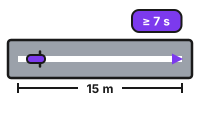
You ride a narrow painted line and you must take seven seconds or more to reach the end of it. Slower is better. Everyone’s instinct is to get it over with, and that instinct is what fails them.
- −32 finishing in under seven seconds
- −32 a wheel touching the line, or a foot touching the ground
This is the item the sheet marks 得複試1次, meaning one re-attempt. Nothing else on the circuit carries that note. If you are going to make your one mistake of the day, make it here.
2. Pedestrian crossing (斑馬紋行人穿越道線)
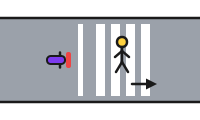
- −32 not stopping, or not letting the pedestrian cross first
- −32 stopping with the front wheel past the stop line
The second one catches careful riders. You did stop, you did yield, and you still failed, because the front wheel is sitting two centimetres over a painted line. Stop early. There is no prize for being close to it.
3. Intersection (交岔路口)
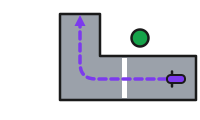
- −32 going through on red
- −32 stopping at a red with the front wheel past the line
Riders who have been in Taiwan a while lose this one out of habit, because creeping into the junction is normal on the street and is a fail on the circuit.
4. Two-stage turn (二段式轉彎)
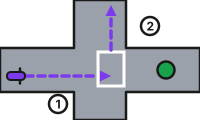
- −32 turning directly instead of doing it in two stages
- −16 not slowing on the way into the box, which the sheet defines as not showing a brake light
- −16 not stopping properly inside the box
The middle one is the one nobody sees coming. The requirement is not “arrive slowly”, it is that a brake light is shown on the approach. Touch the brake on the way in even if you do not need it.
5. Lane change (變換車道)
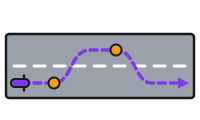
- −32 changing lane without indicating
- −16 not following the required route
- −16 not checking the mirror and turning your head to look left and right first
There is no time limit on this item, which is a gift. Go slowly enough that the indicator always comes first, then the head check, then the wheel.
6. Right-angle turn (直角轉彎)
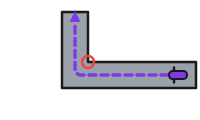
- −16 a wheel on the line
- −16 a foot touching the ground, and this one can be applied repeatedly
Notice that this is a 16-point item, not a 32. It is the obstacle riders are most frightened of and it is one of the more forgiving ones. Take it wide, take it slow, keep your feet up.
7. Stop and go (停車再開)
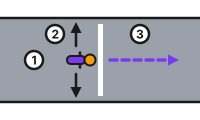
- −32 not stopping, or stopping with the front wheel past the line
- −32 pulling away into a turn without indicating
- −16 not turning your head to check left and right before moving off
That second deduction is new. The gazette’s own amendment note says it was raised to 32 points specifically because riders were moving off without signalling and causing crashes. Any English guide written before mid-2024 has this one at a lower value.
8. Railway crossing (鐵路平交道)
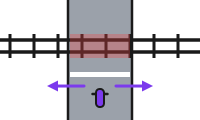
- −32 not stopping to look, or riding across without stopping
- −32 stalling or stopping with the bike inside the sleepers
- −32 stopping with the front wheel past the line
A rolling slow-down is not a stop. It has to be a full stop, and it has to be behind the line, even though there is obviously no train.
The two items being marked the entire time
The last two on the sheet are not places on the circuit. They apply from the moment you set off until the moment you stop, which is why they catch people who thought they had finished the hard part.
9. Riding throughout (全程道路行駛)
Twelve separate deductions live under this heading. The ones worth memorising.
- −16 helmet not worn, or worn with the strap not fastened. This is scored before you have ridden a single metre.
- −16 not checking mirrors and turning your head when moving off or changing lane, and it can be applied every time
- −32 crashing or dropping the bike
- −16 a wheel on a line, applied every time
- −16 not slowing before a railway crossing or a turn. The sheet gives the number, under 15 km/h once the crossing sign or marking is in sight.
- −16 both feet down, −8 one foot down, both applied every time, and neither counted on the right-angle turn where that item’s own rule takes over
- −8 stalling, every time
- −8 riding with your feet dangling instead of on the footboard
- −8 riding with the throttle open against the brake, which the sheet calls not controlling the bike normally
- −32 failing to finish, or skipping any item
The helmet strap one is worth reading twice. It is 16 points, it is entirely free to avoid, and it is gone before the test has started.
10. Other technique (其它技術操作)
- −2 each for a clumsy start, clumsy clutch, clumsy throttle, clumsy braking
These are repeatable, but the whole category is capped at 18 points in total, so ordinary untidiness cannot fail you by itself. This is the only forgiving corner of the sheet.
Watch it being ridden
Every 監理所 films its own circuit and publishes it. These are the official ones, not a YouTuber’s version, and watching a full lap is worth more than any written description including this one.
There are more, one per office, on the official list at 臺中區監理所. If your test is booked at a particular station, look for that station’s own film, because the layout you see will be the layout you ride.
Before you get near the circuit
The riding test is the last of three stages and the booking system enforces the order.
The hazard perception test (危險感知測驗) comes first and it is a hard gate. You cannot book anything else until the result is on your record. It is 10 video clips and you need 8 right. Then the written paper, 50 multiple-choice questions and 85 to pass, drawn entirely from the free official bank. Only then the circuit.
The whole route, with the fees and the paperwork, is in the motorcycle guide.
What the videos will not tell you
Two things about the day itself, one of which is officially published and almost never quoted, and one of which is not.
The circuit opens before the test starts so you can ride the real course. 高雄市區監理所 puts a number on it, 「路考場地開放時間:路考開始前30分鐘至路考開始」, 30 minutes, and adds that it is there to let you learn the layout rather than to run laps until you pass. Other stations are said to open earlier, up to 45 minutes, and most will rent or lend you a bike, but that part varies and is not published. Turning up early enough to ride the course a few times is the single cheapest thing you can do for your chances, and a lot of people arrive too late to use it.
The 120-minute safety lecture (機車安全駕駛講習) is the other one, and it is not part of the riding test. It is free, it has been compulsory for first-time riders since 1 December 2018, and 臺北市區監理所 states that you must complete it 「方可報名考照」, before you may even register. Other stations run it as its own booked session on the morning of the exam, with the written paper in the afternoon, so where it lands on your calendar depends on the station. Either way you book it separately and no station lets you sit without it. The official breakdown is 40 minutes of crash-case video, 50 minutes of classroom theory and 30 minutes of defensive riding, followed by an assessment. Anyone who already holds a light-motorcycle licence is exempt, as is anyone retaking after a revocation.
The honest limits of this page
The point values, the item list and the pass mark all come from the official scoring sheet published in the government gazette on 1 May 2024, which is the current one. Those are firm.
The safety lecture’s length and its place in the process are official too, from 公路局 and from 臺北市區監理所. What is not official is the wider practice window some stations give, and the bikes they rent or lend. Those come from people who have sat the test, and they vary by station.
Rules do change. This page was checked on the date at the foot of it, and if you find something here that no longer matches what happened at your counter, write in and it will be fixed.
Official sources
- 行政院公報 030卷 080期, 普通重型及輕型機車駕駛人路考評分基準與成績紀錄表 (the official scoring sheet, 2024-05-01)
- 公路局 臺中區監理所, 機車路考示範影片 (official demonstration videos)
- 公路局 新竹區監理所, 機車路考扣分項目
- 公路局 高雄市區監理所, 路試考驗科目及評分表
- 公路局, 危險感知測驗 (hazard perception, required before you can book)
- 監理服務網, 考照預約報名 (booking the exam)
- 公路局, 機車安全駕駛講習 (the compulsory 120-minute lecture)
- 臺北市區監理所, 機車駕駛執照考驗 (lecture required before you may register)
- 高雄市區監理所, 考驗場次、時間及報名規定 (circuit opens 30 minutes before)
Checked